CCI · 2022 — 2023

Business aid request platform

A web app where companies apply for public business aid online, and where CCI advisors review, validate and follow each application.

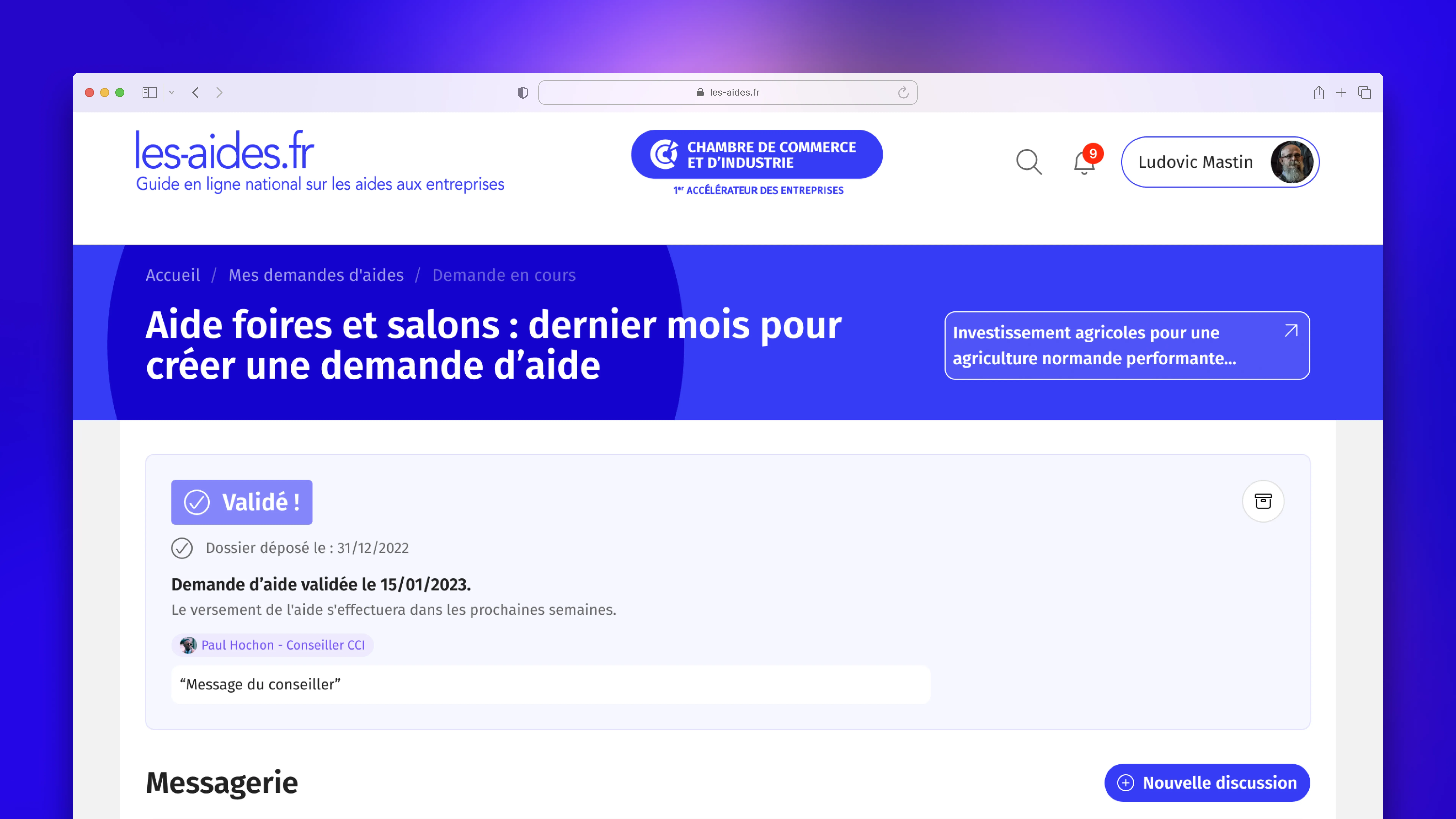
CCI — les-aides.fr, a validated aid request on the applicant side
Role
Product Designer in a pair, no PM: we owned the product calls too
Users
Businesses applying for aid, and CCI advisors
Scope
Design and development of the full application
New
Direct messaging between the business and its advisor
In short

Applying for business aid was a heavy, barely digital process on both sides. With no PM on the project, the two of us designers owned the product calls: ship the business journey first to prove the value, then design the advisor workspace, validating every step with the client on prototypes.

  • 2journeys shipped in two stages: businesses first, advisors next
  • 2prototyped options at every client validation
  • 1single screen to process a case
Context

A heavy process, poorly digitised

Companies requesting aid from the CCI went through a long, mostly offline procedure, and advisors handled each case across scattered tools. The goal of the new concept was to reduce both the time to file an application and the time to process it, with clear steps and a step-by-step guide.

The problem

Filing and processing an aid application took too long for both the company and the advisor.

  • Companies had no clear view of the steps or the documents expected.
  • Advisors followed each case outside any shared tool.
  • Missing documents meant back-and-forth with no single channel to resolve it.
The advisor side

One screen to process a case

The advisor sees the applicant, the status of the application and the missing documents, can validate or refuse the case, and exchanges with the company from the same page. Every action is logged in the case history.

Advisor interface: case detail with missing documents, messaging and latest updates
Advisor case file: status, missing documents, messaging and history.
How I worked

Validating every assumption with the client

  1. MVP slicing

    The business journey first: it showed the project’s value fastest, before investing in the advisor tool.

  2. Sync points

    Regular check-ins with the CCI to validate our assumptions, always on a prototype.

  3. Two options

    At every key step, two prototyped options, so the client chose from something real rather than a description.

  4. Advisor workspace

    Four interviews with advisors, then the processing workspace: one screen, messaging and the case history.

Trade-offs

The calls that shaped the product

Which journey first?

Businesses first, advisors next

We sliced the MVP to ship the application journey first. It is what businesses see, and what proved the project’s value to the CCI.

What settled it: with no PM, we needed fast proof of value to secure the rest of the project.

Not this: Designing both journeys in parallel: more complete on paper, but nothing visible until the end.

Who approves a case?

When to hand a case to a manager for approval

Some requests must be approved or rejected by a line manager. We had to decide when the workflow moves from advisor to manager, without breaking the advisor’s follow-up or the business’s view of its case.

What settled it: how approvals really work at the CCI, as advisors described it in interviews.

Not this: A single-level workflow where the advisor approves everything: simpler to build, but not how it really works.

Align

Letting the client choose on prototypes

With no PM, the client relationship was on us. We held frequent sync points with the CCI to validate each assumption before building it.

For every important decision, we came with two prototyped options. The client chose from something real, and every call we made stayed explainable.

Our method
  • One assumption, one prototype, one client validation.
  • Always two options, never just one.
  • The business journey validated before opening the advisor workspace.

Outcome: no pushback on the project, because the client had already seen and chosen every decision.

Impact

Shorter on both sides of the case

The guided application lists the steps and required documents up front, which cut the time businesses spend submitting. On the advisor side, a case is processed on one screen, and missing documents are sorted out in the messaging instead of email back-and-forth.

Results observed by the CCI teams; no detailed figures shared.

  • Screen to process a case1
  • Channel to sort out a missing document1
  • Journeys shipped, businesses first2