Tymate · 2023 — 4 months

Second-hand ecommerce

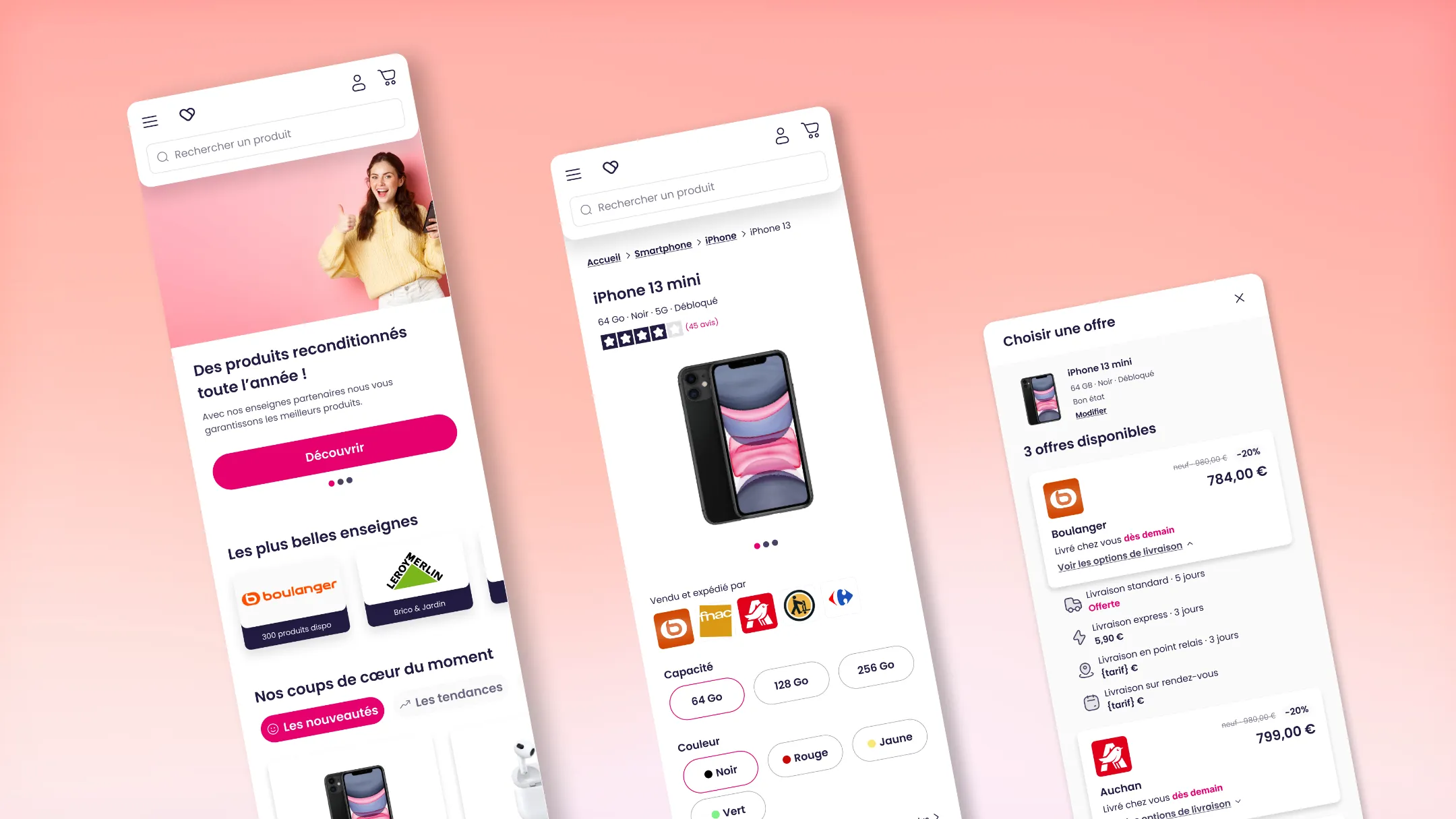
Concept and design for a multi-brand marketplace where customers of an existing brand ecosystem can buy and resell second-hand items.

Tymate — second-hand ecommerce
Role
Product Designer in a pair: concept, information architecture, flows, UI
Team
Agency project, with a client-side PM
Scope
Marketplace concept, MVP, listing and buying flows, trust model
Status
Design delivered; platform not launched by the client
In short

A group of brands shared its customers, but those customers had nowhere to resell. The client-side PM wanted a full marketplace from day one. We convinced her to start with an MVP, weighing each feature’s value against its development cost: guided listing, and trust backed by the brands.

  • 4 monthsfrom concept to delivered design
  • 2flows kept for the MVP: listing and buying
  • 1interface system for every brand in the group
Context

Brands with a shared audience and no resale path

The brands in the ecosystem already shared a customer base and a certain level of trust. What they did not have was any place for a product to have a second life, so resale happened on generic platforms, off-brand and untracked.

The problem

Inside a merchant ecosystem of related brands, there was no platform to buy or resell second-hand products.

  • Resale left the ecosystem entirely, taking the customer relationship with it.
  • Buyers had no way to judge an item’s condition or authenticity.
  • Sellers had to describe, price and ship on their own, so most gave up.
How I worked

Design the trust, then the smallest useful product

  1. Ecosystem mapping

    What each brand could guarantee, and where a shared marketplace made sense.

  2. Trust model

    Condition grading, verification and guarantees defined before touching the catalogue UI.

  3. Value / cost prioritisation

    Each feature rated on the value it brings and its development cost, to define an MVP we could defend.

  4. Listing and buying flows

    Resale designed as a few guided steps, with assisted pricing and shipping rather than free-form.

Trade-offs

The calls that shaped the product

What to launch first?

An MVP rather than a full marketplace

We cut the launch down to two flows, guided listing and buying, backed by the brands’ guarantee. Reviews, peer-to-peer messaging and auctions could wait for users.

What settled it: the value / cost matrix. Those features were expensive to build and worthless while the platform was empty.

Not this: The full marketplace wanted at the start: months of development before learning anything.

What does trust rest on?

Reassurance from the brands, not from reviews

Condition grading and guarantees come from the brand group rather than seller reputation.

What settled it: a new marketplace has no reviews yet; the brands already have their customers’ trust.

Not this: Peer reviews: impossible to bootstrap at launch, and the reason generic resale feels risky.

How should people list an item?

Guided listing, not a free form

Sellers answer a few questions; the platform suggests condition, a price range and shipping.

What settled it: on the generic platforms we studied, free forms produced abandoned or incomparable listings.

Not this: An open form with photos and free text: faster to build, and the main source of unsellable listings elsewhere.

Convince

Bringing a full vision down to an MVP

The client-side PM came with firm ideas: a marketplace needed reviews, messaging and a rich catalogue from day one.

Rather than debate features one by one, we placed each on a value / cost matrix. The conversation moved from “what we must have” to “what teaches us the most for the least”.

What convinced her
  • Without sellers, reviews and messaging stay empty.
  • The brands’ guarantee reassures from day one, with no reputation to build first.
  • Two polished flows can be tested in weeks; a full marketplace takes months.

Outcome: the MVP was approved and the design delivered. The client ultimately did not launch the platform.

Impact

A launch-ready MVP the brands could own

The project delivered a complete concept and a build-ready MVP: trust model, listing and buying flows, multi-brand interface system. It kept the customer, product data and brand experience inside the group. The client did not launch the platform, for its own reasons.

Platform not launched by the client, so no usage data. Happy to walk through the process in detail in person.

  • From concept to delivered design4 months
  • Flows kept for the MVP2
  • Interface system for every brand1
What I took away

In second-hand commerce, the interface is not the product. The trust model is, and everything else is a consequence of it.

What I would do differently: prototype the listing flow with real sellers earlier. Pricing assistance was the step they hesitated on most.